- info@ontarioopenschool.com
- 647-494-4499
-
Unit 100 - 29 Gervais Drive, North York, ON.
M3C 1Y9
Copyright 2024 Ontario Open School Inc. All Rights Reserved.
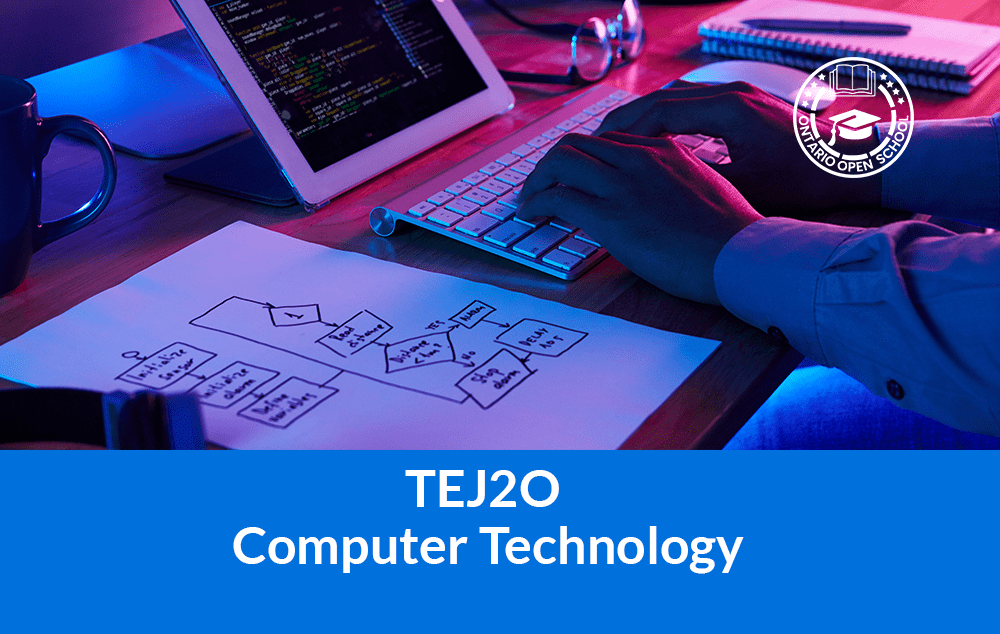
This course introduces students to computer systems, networking, and interfacing, as well as electronics and robotics. Students will assemble, repair, and configure computers with various types of operating systems and application software. Students will build small electronic circuits and write computer programs to control simple peripheral devices or robots. Students will also develop an awareness of related environmental and societal issues and will learn about secondary and postsecondary pathways and career opportunities in computer technology.
Unit Order | Unit Name | Suggested Time |
|---|---|---|
| Unit 1 | Basic Hardware and Software Personal Computer Hardware PC Disassembly and Assembly Software and Operating Systems Networking Basics | 35 hours |
| Unit 2 | Digital Logic Number Systems Data Representation Logic Gates Circuit Schematics and Truth Tables Basic Boolean Algebra Design of Integrated Circuits | 30 hours |
| Unit 3 | Electronics, Robotics and Programming Basic Electronic Components Wiring Schematics Basic Programming Concepts in C++ Interfacing with Arduino | 30 hours |
| Final Evaluation 30% | Portfolio Technological Education Portfolio (ISP) Final Exam | 13 hours 2 hours |
| Total | 110 Hours |
A wide variety of instructional strategies are used to provide learning opportunities to accommodate a variety of learning styles, interests, and ability levels. These strategies include:
|
In – class discussion Problem solving Group discussion Peer partner learning Interviewing Concept formation |
Structured overview Lecture Creative Writing Demonstrations Multimedia Presentation Student Teacher Conference |
Reflective discussion Guided thinking Internet research Homework Assigned questions Inquiry |
Purpose
The primary purpose of assessment is to improve student learning. Assessment relates directly to the expectations for the course.
A variety of assessments for and as learning are conducted on a regular basis to allow ample opportunities for students to improve and ultimately demonstrate their full range of learning and for the teacher to gather information to provide feedback. Assessment tasks relate to the success criteria set out in lesson plans. Success criteria allow students to see what quality looks like.
Evaluation is the process of judging the quality of student work in relation to the achievement chart categories and criteria and assigning a percentage grade to represent that quality. Evaluation is based on gathering evidence of student achievement through:
Assessment for Learning – we provide feedback and coaching. Assessment FOR Learning is the process of seeking and interpreting evidence for the use of learners and their teachers to decide where the learners are in their learning, where they need to go, and how best to go there.
Assessment as Learning – we help students monitor progress, set goals, reflect on their learning
Assessment AS Learning is the process of the explicit fostering of students’ capacity over time to be their own best assessors, but teachers need to start by presenting and modeling external, structured opportunities for students to assess themselves.
Assessment of Learning – we use assessments to provide evaluative statements about student achievement. Assessment OF Learning is the assessment that becomes public and results in statements of symbols
(marks/grades/levels of achievement) about how well students are learning. It often contributes to pivotal decisions that will affect students’ future.
ASSESSMENT TOOLS
|
Assessment and Evaluation Evaluation in this course will be continuous throughout the year and will include a variety of evaluation methods. The tools highlighted will be used for the three different types of assessments |
||
| Assessment as Learning | Assessment for Learning |
Assessment of Learning |
|
Student Product: Learning Logs (anecdotal) Homework Checklist (Units) Self – evaluation sheet |
Student Product:
Pre – tests (scale/rubric) Quizzes (scale/rubric) Homework Peer feedback (anecdotal/checklist) _Vocabulary notebooks (anecdotal) |
Student Product: Assignments Tests (scale/rubric) Exam Journal (Scale /Rubric Project Presentation Essay |
|
Observation: Whole class discussions (anecdotal) |
Observation:
Class discussions (anecdotal) Performance tasks (anecdotal/scale) |
Observation: PowerPoint presentations (rubric) Performance tasks (anecdotal/scale) |
|
Conversation: Student teacher conferences (checklist) Small group discussions Pair work (checklist) |
Conversation:
Student teacher conferences(checklist) Small group discussions (checklist) Peer feedback (anecdotal) |
Conversation: Student teacher conferences (checklist) Small Group Discussion |
Resources
Growing Success: Assessment, Evaluation and Reporting in Ontario Schools (2010)
http://www.edu.gov.on.ca/eng/policyfunding/growSuccess.pdf
School network documents and internet, library.
YouTube information videos
PowerPoint presentations
School MLS system
Grading
Weighting of categories
| Knowledge/Understanding | Thinking/Inquiry | Communication | Application |
| 25% | 25% | 25% | 25% |
|
Percentage of Final Mark |
Categories of Mark Breakdown |
|
70% |
Term work student product (Unit tests, Assignments)
Observations (In class discussions) Conversation (Teacher-Student conferencing) Seminar/Media presentation (Collaboration task) |
| 30% |
Independent Study 10% Final Examination 20% |
Course Grade | Grade 10 |
|---|---|
Course Code | TEJ2O |
Course Category | Technological Education |
Course Type | Open |
Course Delivery | Online |
Course Duration | 8hrs |
Course Credit | 0 |
Copyright 2024 Ontario Open School Inc. All Rights Reserved.